Martes, Marso 8, 2016

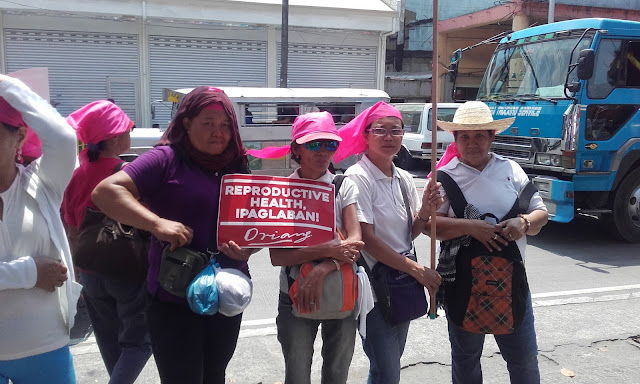
Women's Group ORIANG launched at Plaza Moriones in Tondo


Sanlakas, this International Women's Day, stands in solidarity with the women of the world, especially Fililipinas, in asserting their rights and freedoms towards a more socially just and progressive society.

ORIANG was formed today in a march by some 1,000 women in Plaza Moriones in Tondo, with the theme: “Kalayaan para sa Kababaihan! Pitong Laban ng Kababaihan”. Oriang is a grassroots movement led by women leaders of SANLAKAS, Partido Lakas ng Masa (PLM). Bukluran ng Manggagawang Pilipino (BMP), Kongreso ng Pagkakaisa ng Maralitang Lungsod (KPML), KALAYAAN, Metro Manila Vendors Alliance (MMVA), Koalisyon Pabahay sa Pilipinas (KPP), Makabayan-Pilipinas, and, Aniban ng mga Manggagawa sa Agrikultura (AMA).

The name “Oriang” was derived from the nickname of Gregoria de Jesus, founder and vice-president of the women’s chapter of the Katipunan. Widow to Supremo Gat Andres Bonifacio and later wife to patriot Julio Nakpil, Ka Oryang went beyond the confines of domestic labor to devote her life to free the country from foreign oppressors.

The organizers said, “Ka Oryang symbolized the struggle of plebian women for a better and more egalitarian society, not just for their own families”.

At the march, ORIANG raised seven urgent women’s issues that need to be addressed in the coming elections. Among them: lack of employment and dignfied income; discrimination and unequal treatment in all spheres of society; non-recognition to the rights of women as part of basic human rights including reproductive rights; continuing incidences of rape, violence, and sexual harassment including from their husbands and other family members; the effects of environmental and ecological destruction and its effect on women and their families; the lack of social services for education, healthcare, housing, etc.; and the prevailing disregard to the vital role of women to social progress and social change. The issues form part of the SANLAKAS partylist 7-point pro-people platform.
‪
#‎37Sanlakas‬ Partylist: T'yak Kakampi Ng Kababaihan Laban sa Diskriminasyon at Karahasan!

Biyernes, Enero 22, 2016

Develop a heart and a spine; override the presidential veto on the SSS Pension Hike

PRESS RELEASE
January 22, 2016

Militant workers to Congress:
Develop a heart and a spine;
override the presidential veto on the SSS Pension Hike

Members of the militant labor group Bukluran ng Manggagawang Pilipino (BMP) and Sanlakas partylist held a picket at the Batasan gates today to call on lawmakers to override the presidential veto against a P2,000 increase in the monthly pensioners of the Social Security System.

Leody de Guzman, BMP president said, “We call on our legislators to alleviate the hardship of 1.9 million Filipinos who have to barely survive on a measly pension of P1,200 per month at the twilight of their lives.

Have a Heart as People’s Representatives

“If you are truly representatives of the people, you must, at the very least,have a heart to those who dutifully contributed to the social welfare fundin the hope of living decently upon retirement. The current minimum pension of P1,200 is not even half the cost of living of P5,333 per individual,” the labor leader furthered.

Develop a Spine as a Co-Equal Branch of Government

De Guzman clarified, “We appeal to our legislators to develop a spine by collectively standing up as a co-equal branch to the executive department.  Override the presidential veto by garnerning the required two-thirds vote to defend your just and reasonable proposal for a pension hike, lest the people conclude that members of the august halls of Congress are more concerned with their electoral kitty than the welfare of our aging countrymen”.

Reforms to ensure the viability of the P2,000 SSS Pension Hike

The labor leader, who is also the first nominee of the SANLAKAS party-list in the upcoming May elections, asserted that the SSS has sufficient funds to provide for a P2,000 increase in monthly pensions. He added, “especially if it would increase the collection rate from the present 35-38% and by reducing the administrative and operating costs of the social welfare fund. It is the height of injustice that the SSS executives are receiving millions in bonuses despite their obvious inefficiency and lack of regard for the welfare of the millions of its now destitute member-contributors”.

SSS Execu-thieves, Kapalmuks!

At the protest, the BMP, SANLAKAS and Partido Lakas ng Masa (PLM) brought a huge streamer that listed the millions in bonuses given to members of the SSS board, who they described as “execu-thieves”,“walang hiya” (shameless) and “kapalmuks” (thick-skinned, insensitive). #

Miyerkules, Pebrero 25, 2015

For a Government of the Masses, Not the Elite!

STATEMENT on the 29th anniversary of EDSA 1986
February 22, 2015
Bukluran ng Manggagawang Pilipino (BMP), Partido Lakas ng Masa (PLM), Sanlakas


For a Government of the Masses, Not the Elite!

On the occasion of the 29th anniversary of the People Power uprising in 1986, the workers and the people - under the banner of BMP-PLM-Sanlakas express our unity and support to all forces calling for the ouster of Noynoy Aquino.

Noynoy deserves to be ousted - not just because of allegiations about his incapacity to hold the highest office in the land. More so, he symbolizes the interests of landlords and capitalists, whose greed for power and profit cause the misery and poverty of the Filipino majority.

He is the personification of neoliberal policies of liberalization, deregulation, privatization and labor contractualization that continue to wreck havoc on the lives and welfare of the people. More so, Noynoy is the manifestation of the tyranny of political clans, brought by the rotten and backward system of elite democracy.

The tragedy in Mamasapano that cost the lives of forty four (44) SAF troops, eighteen (18) Moro fighters and five (5) civilians, is but the latest evidence arguing for the ouster of Noynoy as president of the Republic of the Philippines and commander-in-chief of the armed forces. The said dastardly incident is an addition to the ever-growing list of unpresidential errors by the current Malacanang resident, which started at the Quirino Grandstand Bus Hostage Crisis.

Hence, the BMP-PLM-Sanlakas calls on all forces of the anti-Noynoy movement, the workers and the poor demand not just regime change but for meaningful changes in Philppine society. We have learned the bitter lessons of past EDSA upheavals.

We are, likewise, issuing this clarification to personalities and groups calling for the resignation of Noynoy: the mere expression of disgust over the incompetent president is not enough. "P-Noy resign" simply means the ascension of VP Binay as "constitutional successor", in the same way as GMA was sworn in as president during Edsa Dos to replace the ousted Erap Estrada in 2001.

The path to meaningful reforms lies in the extra-constitutional means of removing a president through the concerted action of the workers and the people. It is a crusade that does not limit itself with the parameters of the 1987 Constitution. Because the people's right to struggle against a tyrant is recognized in a Charter that is borne out of the anti-dictatorship and anti-Marcos struggle.

Millions of workers, including the majority who are unorganized, are ready to support a movement to unseat an elitist president, only if it also fights for meaningful reforms that would address their everyday problems.

To those who are calling for Noynoy's ouster, we are proposing a common agenda for living wage, regular jobs, decent housing, social services such as healthcare and education, freedom from political dynasties, etc. Oust Noynoy but his ouster is not enough! For a government of the masses, not the elite!" #

Biyernes, Pebrero 6, 2015

Denying the Bangsamoro of their right to self-determination means denying peace

SANLAKAS
6 February 2015

Statement on the Mamasapano Battle
DENYING THE BANGSAMORO OF THEIR RIGHT TO SELF-DETERMINATION MEANS DENYING PEACE

SANLAKAS fully supports all progressively principled and meaningful solutions to achieve a lasting peace for Mindanao directly related to the Bangsamoro Question. Any such measures aimed at resolving this national question must be based on concretely attaining real social justice for the oppressed Bangsamoro nation. Achieving this will be a strategic answer to a centuries-old dilemma that has haunted the Philippine State.

Tensions once more rose on January 25, 2015 in the aftershock of a bloody battle in Mamasapano, Maguindanao. It reportedly resulted in the deaths of 44 policemen of the Special Action Force of the Philippine National Police (SAF-PNP) and 18 fighters of the Moro Islamic Liberation Front-Bangsamoro Islamic Armed Forces (MILF-BIAF); scores of civilians and non-combatants were also killed in the crossfire, with many others wounded. Likewise, the spokesperson of the Bangsamoro Islamic Freedom Movement-Bangsamoro Islamic Freedom Fighters (BIFM-BIFF) claimed that its own fighters also battled with the same composite SAF unit. In this very tragic aftermath, SANLAKAS expresses its sincerest condolences and heartfelt sympathies to all the families and loved ones of the protagonists who lost their lives in Mindanao’s latest, but avoidable carnage.

The Bangsamoro people have long suffered gross and untold historic injustices since the US occupation and at the hands of the Philippine State led by its elite. As a result, not a few Bangsamoro have taken up arms to resist and fight back. And they do so to shape their own national future as a nation. In this regard, therefore, it is now totally imperative that the historically-oppressed peoples of the Bangsamoro homeland be allowed to collectively express, and to rightfully determine their own national aspirations as a free and sovereign people.

SANLAKAS believes that for peace to be achieved in Mindanao, the Bangsamoro people’s right to self-determination must be respected and recognized. Their struggle is no different from our nation’s struggle under centuries of colonial subjugation, against the tyranny of the Spanish, American and Japanese colonizers. Thus, Filipinos should be in the best position to understand that there can be no genuine peace if there is no social justice, that peace would remain an elusive ideal when entire nations and oppressed ethno-cultural communities are deprived of their right to determine their own destinies. We, therefore, cannot become colonizers of the Bangsamoro people by refusing and denying them what previous generations of Filipinos steadfastly fought and died for, that is – the right to self-determination.

However, the current national political situation is one that is sharply alarming. It starkly reflects the direct outcome of the Battle in Mamasapano. Rabid war proponents and right-wing tendencies are already exploiting the situation for maximum explosive effect upon the Filipino national psyche to trigger yet another terribly devastating ‘All-out War’ against the Bangsamoro nation.

In recent public pronouncements by these reactionary spoilers of the ongoing peace process between the Government of the Philippines (GPH) and the MILF, they now want the so-called Bangsamoro Basic Law (BBL), the lynchpin instrument for an acceptable peace earlier approved by the MILF’s Central Committee, to be junked. While they earlier criticized the GPH-MILF peace process, specifically the BBL, on constitutional grounds, they now want it totally scrapped in reaction to the unfortunate loss of the 44 SAF troops.

AMERICA’S DAGGER IN MINDANAO

Yet amidst all this confused tension, the interventionist maneuvers and ploys of the US persist. America’s openly expressed role in the Philippines is to directly assist Philippine state security forces in the latter’s fight against international terrorism, as clearly witnessed in the aftermath of the Mamasapano Battle. On this front, Washington’s intrusion is fundamentally linked to its geostrategic agenda to secure and dominate access to Asia’s vast and fast-growing regional economic markets via political-security means. This is chiefly aimed at the current survival of America’s own capitalist-imperialist system after the near-collapse of Wall Street on September 15, 2008, plus the global capitalist system’s ensuing crisis. Thus, it is centrally focused on pre-positioning US military forces across bases within the region to protect American profits and interests, but under the pretext of fighting international terrorism in collaboration with its puppet states.

In this setting, American strategic interests intend to transform Mindanao, including the Bangsamoro homeland, into a forward projection base akin to a globally-extended dagger. This ‘American dagger’ will be aimed (externally) at its top regional rival, China; although its real intentions of doing so will be hidden from public view. Yet at the same time, it will also be targeted (internally) on “international terrorist targets”, as repeatedly stated in public. This latter justification is now used to veil America’s primary covert intentions in order for it to use Mindanao as a major base of operations for its flanking maneuvers against Beijing. Through this approach, the US can readily take full advantage of its relations with both the PNoy Regime and the MILF and thus, be in a position to exploit greater political leverage and economic gains from both. For as long as American imperialism’s regional scheme to counter China is secured, the outcome of the Philippine State’s peace process with the Bangsamoro would not matter much to the US.

For now, America’s presence in our country still reflects its post-9/11 ‘Global War of Terror’ legacy. It is precisely this militarist aspect of US imperialism’s aggressive worldwide thrust which the PNoy Regime has eagerly invited and consciously welcomed onto Philippine soil. And it is Mindanao which has already become a major battleground for US imperialism’s unfolding shadow war throughout the area. Alas, our country is now reaping what Malacañang has so earnestly sowed.

THE SANLAKAS STANDPOINT

Another war is definitely not in the interests of both the Filipino and Bangsamoro working classes and poor masses who will stand to suffer the most. We must shudder at the thought of mothers losing their sons and daughters, of families torn apart, of homes deserted, of communities displaced and razed to the ground as a consequence of yet another reactionary war.

Hence, SANLAKAS appeals upon all democratic and peace-loving peoples to join it in undertaking a collective national stand for genuine peace concerning the Bangsamoro nation. SANLAKAS now calls upon the Filipino masses to urgently demand for, and to advance the following positions:

• The Bangsamoro nation’s right to self-determination must be fully respected and recognized as a democratic principle. Its pursuit and outcome must be plainly upheld and clearly accepted by the Philippine State and its majority Filipino nation.

• As the Head of State, President Noynoy Aquino, as well as ranking officials of the Philippine National Police (PNP) who masterminded Oplan Wolverine, must take full responsibility and accept total accountability for criminal negligence. The President cannot pass the blame for an operation executed under the auspices of his Office. Command responsibility dictates accountability.

• The current framework objectives of the GPH-MILF Peace Process must be allowed to reach a just conclusion by both signatory parties; and all reactionary spoilers to the peace process must be resisted and stopped.

• The peace process in Mindanao must be broadened to greatly encompass and include other political factions/formations who are not presently involved in the GPH-MILF Peace Process in recognition of their right to self-determination. In this new multi-front peace process context, the general masses of the Bangsamoro nation must also be recognized, encouraged and allowed to actively and directly participate in the negotiations proper in order to help bring about deeper and enhanced solutions to the Bangsamoro Question.

• The dual-faced character and dangerous intentions of US imperialism, both inside the Philippines and in its lingering engagement with the MILF, must be totally unmasked and exposed before the Filipino and Bangsamoro peoples. This is very necessary so that both sides can both learn to build confidence as peace partners together.

• All US military forces in the Philippines, especially those operating in Mindanao, must right away be expelled from the country; and relatedly, all bilateral defense agreements and war instruments between Manila and Washington should promptly be abrogated. Effectively, we must pursue an independent and progressive foreign policy – one which will not compromise the sovereignty of the peoples within the Philippine State.

• The establishment of a multi-stakeholder ‘Independent People’s Commission of Inquiry’ must immediately be undertaken. Its role shall be to ferret out the truth as to what really happened before, during and after the January 25, 2015 Battle in Mamaspano. This is needed in order to establish and assign official accountability on the appropriate government and PNP officials (aside from PNoy himself), and to settle the issue publicly once and for all. The Commission’s mandate, scope and functions shall be parallel to the official investigations being pursued by various government bodies. Government investigations must result in actual prosecution of those responsible.###

Huwebes, Oktubre 16, 2014

Emergency powers will NOT solve the real power crisis

Emergency powers will NOT solve the real power crisis
Oktubre 16, 2014 

Atty. Aaron Pedrosa
Secretary-General, SANLAKAS

The government-forecasted power crisis has triggered a frenzy in the officialdom to scamper for emergency powers as its solution. No less than President Benigno Aquino III now seeks congressional imprimatur through a joint resolution of both chambers –the Senate and House of Representatives – to abate an imminent shortage of electricity supply invoking Section 71 of Republic Act 9136 or the Electric Power Industry reform Act (EPIRA) of 2001.

Under the same provision, the determination as to the existence of an “imminent shortage” of electricity supply is solely lodged on the Chief Executive who may then be empowered by Congress through a joint resolution to establish additional generating capacity to augment the expected power deficit.

This begs the question: Is there really a “power crisis” as a consequence of a significant lack of power supply? For even the head of the Joint Congressional Power Commission (JCPC), Sen. Serge Osmena, declares that there is no power crisis.

According to the Energy Department’s projection a spike in demand from 8,717 MW for 2014 to 9,011 MW during the first half of 2015 will require an additional 400-500 MW generating capacity to absorb the increased power requirements in Luzon.

What is not explicitly explained to the public is that the shortfall will be due to the scheduled preventive maintenance shutdown of the Malampaya gas production facilities in March 2015. The shutdown will then set in motion the fall in electricity supply in Luzon. What the government intends to do is to rent out power barges and diesel generation sets at an estimated contract price of P14Billion for a two-year lease. This short-sighted approach does not address strategic problems plaguing a deregulated power industry. It at best diverts the public from two things: firstly, that the so-called power crisis is contrived; and secondly, it overshadows the real power crisis that has defined the industry for more than a decade now.

In the present set-up, energy officials, power producers and distribution utilities determine the demand and supply forecast for the power sector. This forecasting modality is usually based on a projected economic growth based on the demographics of a certain locality. The totality of these projections is embodied in the government’s Philippine Energy Plan (PEP) which paints a 30-year planning horizon. The forecasting in itself is an exclusive domain for power players and providers leaving out other stakeholders especially the consumers. No one can therefore contest the figures being fed to the public. On a parallel plane, the President’s determination of a power shortage by 2015 is one based on conjecture absent the substantiation of the power crisis being asserted by the administration.

To address the “power crisis”, other government officials offer short-term solutions such as accessing the 3,900 MW “embedded power” or idle power from private firms an arrangement which according to Rep. Reynaldo Umali will only cost the government P200M. Another proposal is the interruptible load program (ILP), a voluntary scheme which would entail a self-impose drop in consumption from participating firms such as malls, industries, among others. Yet, another proposal is the immediate repair of the Private Sector Assets and Liabilities Management Corporation (PSALM)-owned 650 Malaya thermal plant for it to yield an additional 300MW by 2015.

Truth be told, these proposals will never prosper for EPIRA dictates that government cannot provide itself greater stake in power generation. Rather, the overarching principles embodied in the EPIRA, directs the government to relinquish this to the private sector. Thus, the government abrogated its responsibility of providing for the power needs of the people in favour of corporations and private interest and now responds in the same fashion to address its self-declared power crisis, a crisis of its own making.

Completing the picture are twenty-six approved coal plant projects that will be built from now until 2020. With the recent setback experienced by the government with the issuance of a temporary environmental protection order (TEPO) against the 300 MW Redondo coal plant project, the grant of emergency powers will ensure that any legal challenge against these projects will be effortlessly warded off thus ultimately ensuring that the spadework for their construction will be unhampered and unchallenged. Twenty-six coal plants on top of the seventeen existing plants will lock in the country into coal dependence.

All these intramurals on the grant of emergency powers overshadow the real power crisis that has beset the sector for more than a decade now. To date, 2.7 million households remain without access to electricity; the country’s power rates are the most expensive in Asia and rank fifth in the world; market manipulation and collusion are at its worst with prices being manipulated in the Wholesale Electricity Spot Market (WESM), defying a cornerstone promise of EPIRA – of providing affordable and reliable electricity to the people. More than 13 years after EPIRA was passed, five families control the power industry.  

Emergency powers will only result in socializing more obligations that the government intends to pursue. To this day, we are paying for the take or pay provisions and sovereign guarantees extended by the Ramos Administration when it was granted emergency powers allowing it to enter into lopsided supply contracts with independent power producers. That burden will be augmented with the proposal to enter into contracts with private firms for the lease of their generation sets. It is the people who will in the end foot the bill.

To add insult, we are reduced to a more vulnerable state in the context of climate change with the approval of 26 privately owned coal plant projects. Coal plants are the greatest emitters of carbon dioxide whose heavy concentrations in the atmosphere drive climate change. Even as a country battered with the strongest typhoon in recorded history to make landfall, the Aquino Administration opts to look the other way, oblivious to the realities of climate change impacts experienced by countries like the Philippines which is among the most vulnerable to climate change.

The power crisis is bigger than a mere projected shortfall. It requires a solution that recognizes the failure of a paradigm that puts the burden of providing for our power needs in private hands. Emergency power is not the solution.

Repeal EPIRA Now!
Resist Coal!
Resist Emergency Powers!